<- back to thoughts
How many paths could your life have taken?
How many can it take from now?
august 2026 • reflection, inspiration • 6 min read
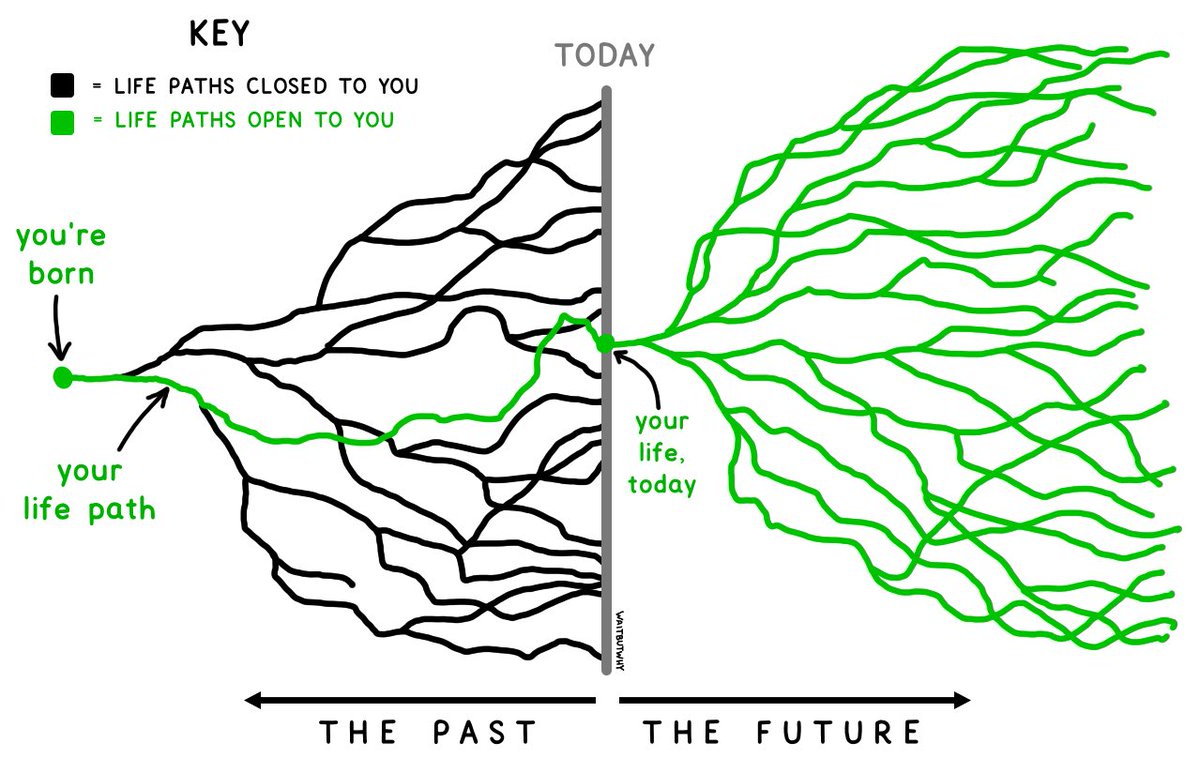
Why is this image meaningful?
The image above, shared by Tim Urban, is a summary of the following key concepts, most of which I adhere to. In this entry, I attempt to explain each of their place in the image, as well as their relevance in a more detailed fashion.
The Butterfly Effect
The Butterfly Effect is fairly well-known to pop culture. There's even a scene in Doctor Strange (2016) mildly referring to it.
If you didn't catch either reference, here's a summary. The effect gets its name from the idea that a butterfly flapping its wings in one part of the world could, through a long chain of events, lead to a hurricane in another part of the world.
That explanation never really made sense to me, so let's talk about burnt toast instead.
Imagine you've made a tiny decision that led to you burning the toast in your toaster. You're now 5 minutes late to work, and as you drive to the office, you see a car crash on your way.
Had your toast not been burnt, there's a chance you could have been a part of that crash.
Small Changes --> Huge Consequences.
(Also, this is mentioned in every time travel movie ever.)
In real life, we notice the butterfly effect only during somewhat larger decisions.
- What if I chose the other high school?
- What if I asked that girl out?
The Butterfly Effect is the reason why the paths diverge so much. Without it, there would be no anxiety about the future, nor any particular guilt about pathways you've lost in the past.
The End of History Illusion
Do you remember something you did, maybe a year, decade, or forever ago that you would never do today? Maybe it was a joke you made or a shirt you wore, but what's important to understand is that this embarassment is a sign that you have grown as a person.
The End of History Illusion simply describes the phenomenon where we think that this growth is always in our past. This is not the case. Teenagers and senior citizens alike underestimate how much their personality and tastes will change in the years to come.
Going back to the paths on the photo, by seeing past the illusion we're able to dismiss the idea that as we grow older, the number of paths available to us decreases, either in quality or quantity.
At any point in our lives, whether obvious or not, there is significant possibility for change.
In University:
- Challenging your perspectives by joining the drama club instead of the math club (positive)
- Believing that your high school study habits will be enough, and that there is no further growth to be had (negative)
Note that this change can be both positive and negative. Resting on your laurels is in itself a negative change. The End of History illusion shows us that there is no point in which future development experiences signifcant (enough) diminishing returns. There are always more paths available.
Application: The Surface Area of Luck
Insofar, we've established that small changes lead to huge consequences, and that this effect is present regardless of your circumstances (age, employment, experience, etc.)
Great for curiosity, but I think this last section is the most important because it ties these two ideas together in an actionable step. Before that, however, we must establish the importance of luck as a role of success.
Innate Talent, Hardwork, and Success
In Outliers by Malcolm Gladwell, he describes how success (especially in the cultural West, with its individuality and social mobility) is perceived as a linear expression of one's effort, grit, intelligence, or any other such personal qualities. In fact, even as broader culture shifted away from natural genius (Einstein, Newton) to hardwork and drive (Goggins, Musk), it's shown in the novel again and again how invisible factors (often arbitrarily) lead to changes in outcome with total abstraction of the person's actual decisions.
Some examples:
Hockey Players are significantly likely to be born in the earlier months of the year. An early birthday, especially during younger years when physical development is incredibly fast, means that you are simply bigger, stronger, and more adept than your younger teammates. This means:
- you become favoured by coaches, get more time on the ice, and therefore get more practice
- more practice means you get better, which creates a positive feedback loop
- that feedback loop means that when developmental differences even out when you're older, the advantage you had when you were younger has compounded so significantly that at this point, you have an actual advantage.
40%
of elite Canadian hockey players are born in January, February, or March. Gladwell shows that 40% are born in Q1, 30% in Q2, 20% in Q3, and only 10% in Q4. 10 percent!
4x
A player born in January is nearly four times more likely to reach elite junior hockey than one born in December.
Note that this advantage was 1. entirely independent of any of the player's individual actions, 2. was entirely arbitrary, and 3. could reasonably go totally unnoticed. Since Canada has set January 1st as the cutoff, players could have as much as an 11-month headstart over their peers, and still have their achievements chalked up to innate talent or hardwork alone.
In the book, Gladwell goes over example after example of similar phenomena. Gifted programs, studies of IQ and its correlation to success, and about health outcomes in hotly contested works. Even academics fall prey to this broader culture that hardwork and intelligence alone serve as a sufficient predictor of success.
Luck
Mathematically, luck matters for success. (Take my word on that, or watch this video by Veritasium: )
The way to increase that luck is simple; increase your surface area.
What does that actually mean?
Let's say that over the course of your career, there are 100 events that you will attend total. Networking events, ice cream socials, coffee chats, whatever. Everytime you go to one of these events but stay silent in a corner instead of speaking with others, or worse, stay home because you're lazy, you are missing out on an incredible amount of potential luck.
At one of these events could be a golden ticket, someone with connections to a job you want.
It could be your future co-founder, friend group, or romantic partner.
Going back to the previous two sections: at any point in your life, small changes lead to huge consequences.
By increasing your surface area, you increase your luck, which increases the chance that you will access those small changes.
Obviously, you won't always be right. Sometimes a conference is just a boring presentation that could've been an email. However, I've found overwhelmingly that the good outweighs the bad in this case.
Nearly every major milestone and change in my life can be traced back to a tiny decision. That could be seen as a grim realization, and somewhat disempowering.
But instead, I see it and have used it as a reason to wake up at 5 am for a conference I have to commute 3 hours for. To attend a run club's first meeting when I didn't feel like running would be that appealing anyway. To put myself out there when it would be far easier to just observe and keep my thoughts to myself.
I think that it should be a motivating factor for you, too.
more from reflection
Core Values1 min read